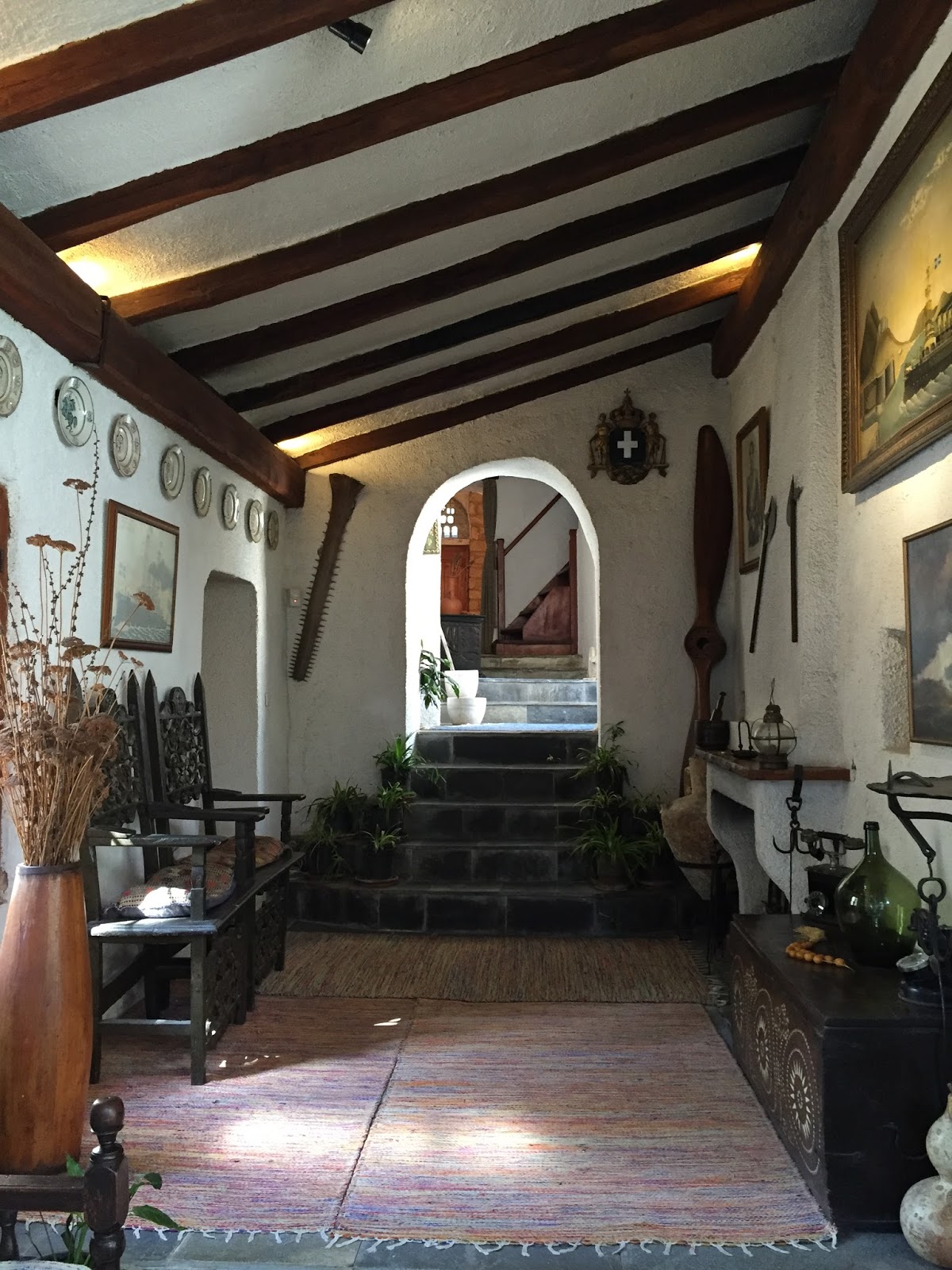
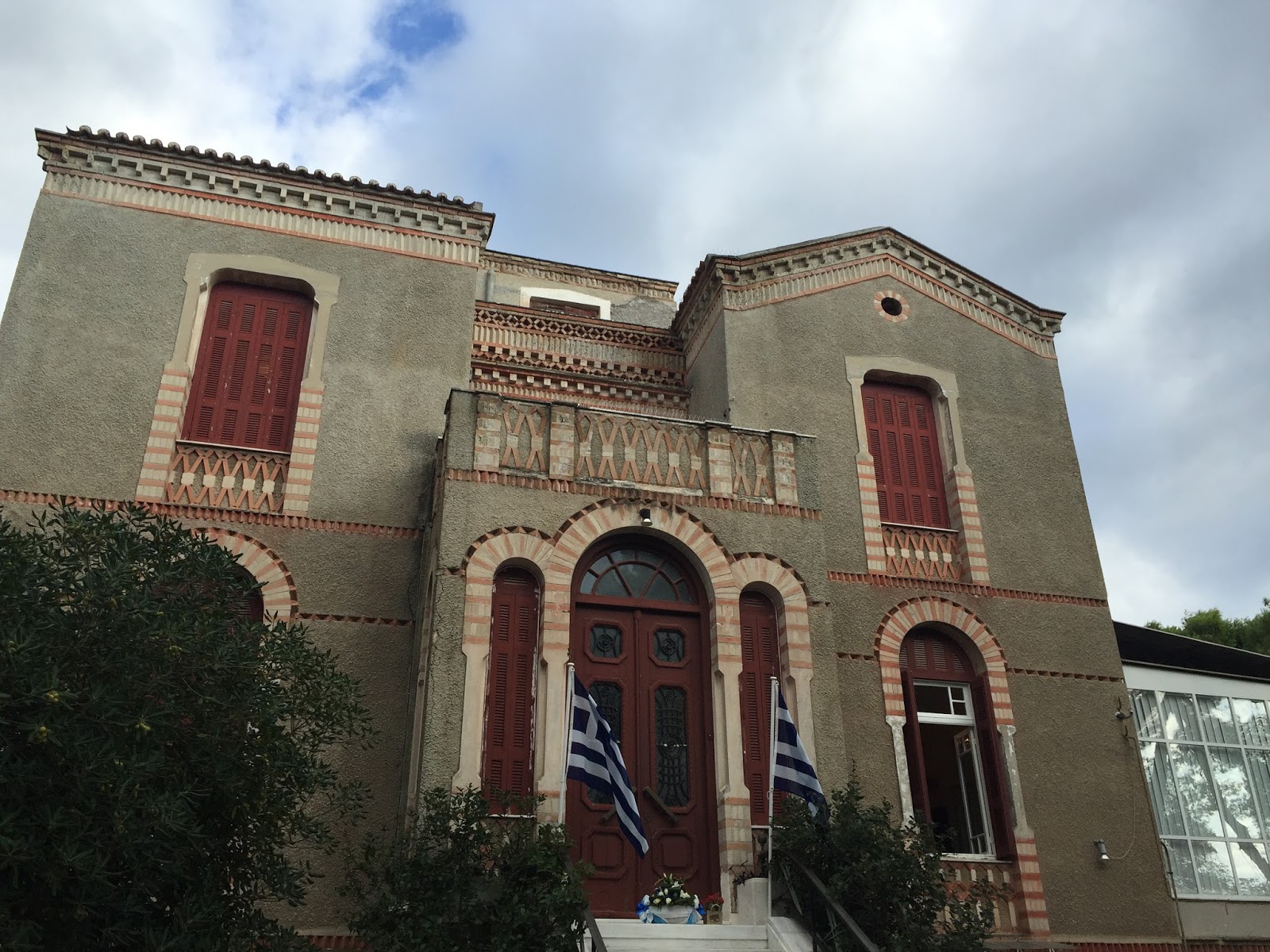
First stop at kifisia to Kouvoutsakis Art Istitute.
Kifissia or Kifisia is one of the most expensive northern suburbs of Athens, Greece,
mainly accessed via Kifissias Avenue, running all the way from central
Athens up to Theseos Avenue in the suburb of Nea Erythraia. It has
traditionally been home to rich Greek families and major Greek political families. (By Wikipedia)
Kouvoutsakis Art Istitute.
Unfortunately, they didn't allow me to take any pictures, only one very quickly. I found it really awkward. I have been to many museums in Greece and abroad as well, never happened before.
Well, there is always a first time for everything. I have to say that when I asked, why you couldn't take any pictures they told me it has to do with the copyright and you can see the whole collection throught their website.
Next stop at Monastery of Penteli.
The Ceonobic Monastery of the Dormition of the Theotokos in Pendeli
was founded in 1578 by Bishop Timotheos of Evripou (Evia), the memory of which
honors our Church on 16 August. The Monastery is located roughly 18 kilometers
from the center of Athens and is built in the Southern side of Pendeliko
Mountain at altitude of around 430 meters.
The Holy Monastery from its founding until the end of the Turkish
occupation was under the jurisdiction of the Ecumenical Patriarchate of Constantinople.
During this time, Abbot Ierotheos of Pendeli Monastery travelled to Constantinople where he was able to secure the Stavropegaic
merit of the Monastery from Patriarch Jeremias the B' (1572-1595) with a sigil,
which unfortunately has not been recovered. A renewal of the Patriarchal privilege
was granted by a second sigil from Patriarch Dionysius D' of Constantinople in
the year 1678. In 1858 the Monastery came under the jurisdiction of the Metropolitan Church
of Athens. The Sultans occasionally offered various firmans that guaranteed the
privileges and the rights of the Monastery, though these firmans were often abolished
resulting in continued pillages. Many were the times that the Holy Monastery bore
witness to pillages such as during the fall of Athens to Morozini (1688-1690)
and another that took place during the battles for independence against the Turks
in 1821, were the pillage was the result of the Holy Monastery's contribution
to the efforts for the independence of the nation.
In 1692 with a Patriarchal sigil the Monastery was amalgamated along
with the Holy Monastery
of Ntaou Pendeli and the Holy
Monastery of Saint Nicholas Kalision. Today, however they are once again independent.
In 1778 the holy Monastery constituted the shelter for the residents
of Athens, which along with their
Metropolitan Gabriel of Athens remained on the grounds of the Monastery
in order to avoid a horrible epidemic of plague which decimated a large part of
population of Athens. These citizens were cared for by the Monastery for roughly
two years.
The Holy Monastery was renovated in the year 1768 and in 1858 the
building was extended in order to accommodate approximately 120 monks. During
the time of Abbot Cyrillos B’ the main Church was repaired and decorated. Today
in the Monahologio (a list of Monks serving the Monastery) of the Monastery there
are 58 monks and hieromonks registered, 17 monks reside permanently in the Monastery
and 1 is a postulant. The Monastery also includes monuments of significant traditional
and historical value such as the Museum of the Monastery and the Main Church or Catholicon. (By http://www.gtp.gr)
Here are some pictures from my visit:
Last stop at The Mansion of Sophie de Plaisance.
In 1802, Sophie married Anne-Charles Lebrun
, the eldest son of Charles-François Lebrun later duc de Plaisance (this last one who along with Napoleon Bonaparte had served as one of three Consuls
of France from 1799-1804). The marriage was unhappy and the couple
separated without ever taking divorce. Sophie lived in Italy while the
Duc served as the Governor of Holland from 1811-1813.
Upon the outbreak of the Greek War of Independence, the Duchess and her daughter generously supported the Greek cause and in 1830, they moved to Nafplion, the capital of Greece at that time and she was reacquainted with the Greek leader John Capodistria whom she had met in Paris
in 1826. She became an ardent financial supporter of public education.
Eventually, she became an opponent of Capodistrias, and after a 17-month
stay, she left for Italy. When Capodistrias was assassinated by Konstantinos Mavromichalis and his nephew Georgios Mavromichalis, she spoke out against the way Capodistrias had run the Greek government.
In 1834, the Duchess returned to Greece and settled in the new capital Athens. She purchased large amounts of agricultural land chiefly near Mt. Penteli, but all around Athens. She engaged the Greek architect, Stamatios Kleanthis to design a palace for her on the slopes of Mt. Penteli. Meanwhile, in 1836, the Duchess and her daughter traveled to Beirut,
where Eliza died of pneumonia. Such was the sorrow of the Duchess that
she had her daughter's body embalmed and returned to Athens where it was
placed in a crypt under her temporary home on Peiraios Street.
Kleanthis completed the Tower of the Duchess of Plaisance in 1841 and
then set to work on Villa Illisia, which was completed in 1848. Today
the Villa Illisia is the site of the Byzantine Museum.
A central fixture in the social life of Othonian Athens, the Duchess
would host symposia on various topics of religion and politics in her
palace. She was also known to dole out funds and titles of courtesy to
those whom she found favorable. Something of an iconoclast, the Duchess
rejected the prevailing faith, Greek Orthodoxy and instead converted to Judaism. She sponsored the building of a Jewish temple in Halkida, Euboea.
Later in life, she commissioned Kleanthis to begin the construction
of a final home and resting place for her beloved daughter's remains,
the Castle of Rododafni. She would never live to see the house
completed. In 1847, it caught fire and was burned to the ground. After
that, the Duchess withdrew from public life only agreeing to see her old
friend, Fotini Mavromichali, Lady-in-waiting for Queen consort Amalia of Oldenburg . She died in 1854 and her nephew sold her lands to the Greek state. She is buried with her daughter in her Tower near Penteli. (By Wikipedia)
Here are a few pictures from my visit: